
“I have heard a lot about Onda lifting.
Does it really work?”
I have been hearing this question more often during consultations lately.
With new devices appearing every year,
it is understandable to wonder which treatment suits you and whether a popular device will actually help.
Onda is a relatively recent addition, so limited information can make the decision feel even harder.

People often ask, “Does it work?” or “What is good about it?”
But those questions are not easy to answer straight away.
Even a useful treatment
may suit one person well
and fall short of another person's expectations.
What I can say is that more people are asking about Onda at skin clinics in Gangnam.
This may reflect the particular advantages it offers, rather than simply a passing trend.
Today, I would like to look more closely at the reasons for that interest.
This reflects my approach to care.
A different approach: microwave technology
Many familiar treatments use radiofrequency (RF) or high-intensity focused ultrasound (HIFU) energy.
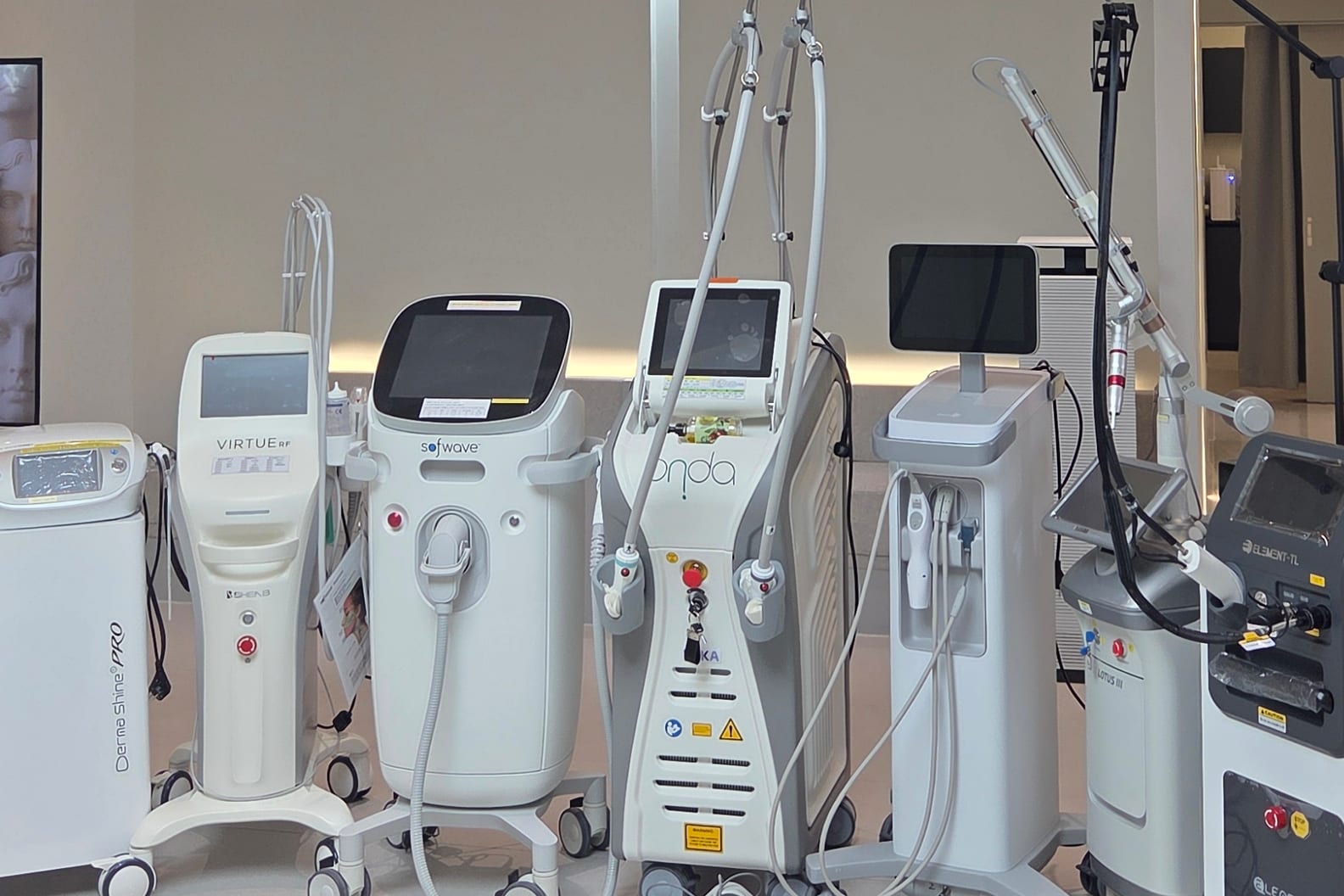
Onda takes a different approach.
As you may have seen when researching it, Onda uses microwave energy, a very high-frequency electromagnetic wave.
People often respond by asking:
“Microwaves?
Like a microwave oven?”
The underlying principle is similar.
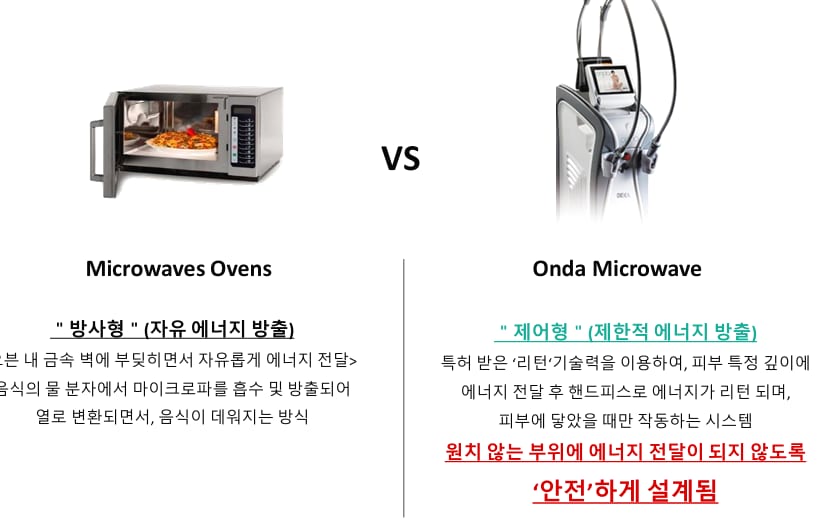
But it helps to look beyond the simple image of heating something up.
Rather than cooking food from the surface inward, a microwave oven interacts with water-containing areas to generate heat within the food.
This lifting treatment uses a related principle.
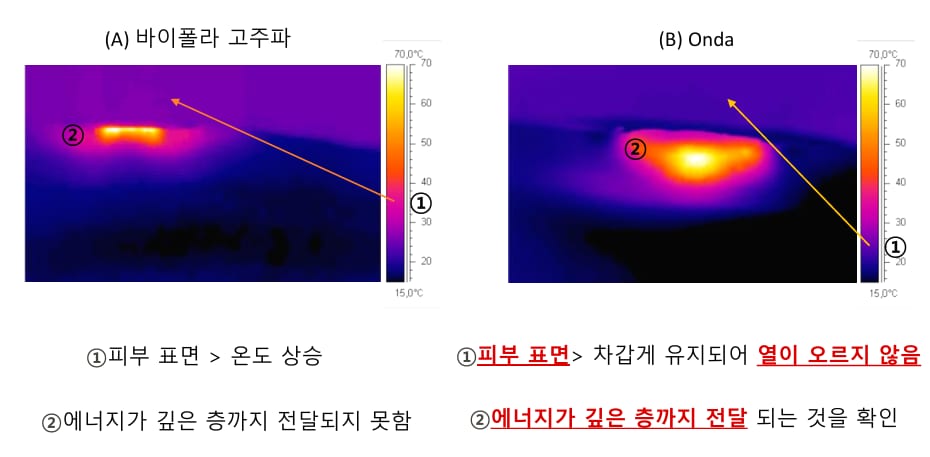
Instead of indiscriminately heating all the skin,
it is designed to selectively deliver heat
to deeper layers containing water.
This allows it to focus stimulation on layers involved in firmness, with comparatively less irritation at the surface.
Curious about the differences between Thermage and Onda? Read more.
Different approaches at different depths
Onda can be used on both the face and body.
This is possible because it uses two handpieces.
They work at different depths: 3mm and 7mm.
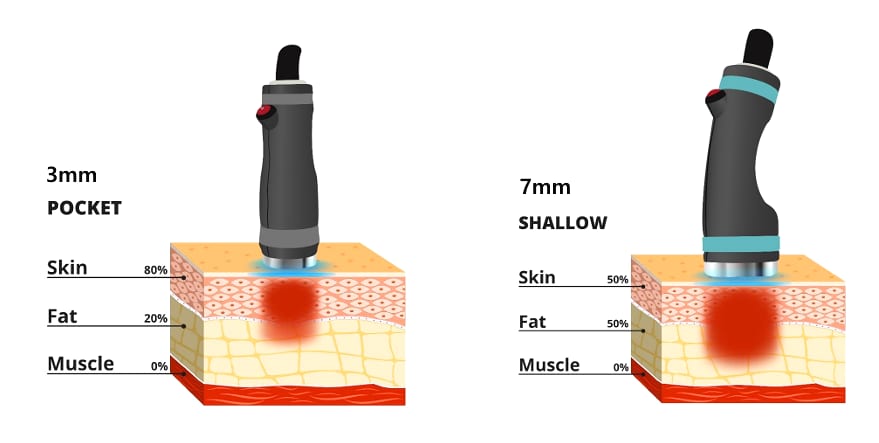
The 7mm handpiece
can reach the subcutaneous fat layer
and the supporting structures beneath it.
Heating this area may encourage natural fat breakdown while also helping improve firmness.
It may therefore be considered by people hoping to reduce localized fat.
It may be suitable for areas such as the upper arms, abdomen, and thighs, where both fat reduction and improved firmness in loose skin are desired.
On the face, it can also be used in areas where fat is concentrated, such as a double chin.
The 3mm handpiece, by contrast,
targets the dermis.
The dermis contains collagen and elastin, which contribute to skin density, elasticity, and texture.
This handpiece may encourage collagen fibers in the dermis to reorganize and contract, giving the skin a firmer feel.
The two handpieces have
distinct roles,
allowing treatment to be tailored
to the condition of different areas of the face and body.
Curious about the differences between Sofwave, Thermage, and Onda? Read more.
A built-in cooling system
“I had the treatment,
but I am not sure it made a difference…”
Occasionally, people come to our clinic with this concern.
One possibility is that the treatment passed too quickly over the area.
As we often explain at the clinic,
for a lifting effect,
energy needs to be delivered properly
to the correct layer
and the required depth.
With Onda in particular, tissue needs to be heated enough to produce changes in collagen.
If this does not happen, the thermal coagulation needed for lifting may not develop, and the effect may be limited.
Yet even when sufficient energy is needed, heat or discomfort can make it difficult to increase the setting.
This is why the device includes a contact cooling system.
It monitors the skin's surface temperature throughout treatment.
It also adjusts cooling in real time to prevent unnecessary surface heating.
This can help reduce discomfort while allowing adequate heat to reach the intended depth.
I have outlined the reasons people are interested in this treatment,
but describing its advantages does not mean everyone should have it.
Each person's skin condition, degree of sagging, and goals are different.
Onda may be suitable, it may need to be combined with another lifting treatment, or lifting may not be needed at all.
What matters is choosing a skin clinic
that assesses your condition carefully
and recommends an approach suited to you.
If that assessment suggests Onda is appropriate, but you are still unsure because the device feels unfamiliar,
I hope the features discussed here help you understand the recommendation.
I hope this article helps you make a choice that fits your needs.
Thank you for reading.
This was Dr. Kim Min Young, Medical Director of INOBEL CLINIC.
< Related reading >
<INOBEL CLINIC notice> | ||
To give each patient careful attention, we see patients by appointment only. This means an appointment may not be available right away, and we appreciate your understanding. We would like to help as many people as we can, but for the quality of consultation and treatment we made this decision with care. Thank you for understanding. |
Mon–Fri 10:00 - 20:00 Lunch break 14:00 - 15:00 Saturday 10:00 - 16:00 Sunday 10:00 - 16:00 | ||
02-6958-5882 |